

Learn all the requirements for personal loans in Puerto Rico
.svg)


- Gather your ID, proof of income, and credit details before you apply.
- Confirm the lender is licensed by the OCIF in Puerto Rico.
- Borrow only what you can comfortably repay and review the term.
- If you have an ITIN, ask each lender which documents it accepts.
- Confirm rates on the lender's legal pages, not on blogs.
Getting a personal loan in Puerto Rico starts with a simple step: gathering the right documents. The Small Personal Loans Act (Act No. 106 of 1965) requires licensed lenders to accept applications starting at $150, so real options exist even for modest amounts. Even so, each lender asks for its own mix of identification, proof of income, and credit data.
In this guide you'll learn which requirements you'll typically be asked for, which documents to prepare, and how a bank, a credit union, and a fintech differ when you apply. You'll also see how a soft pull works, what happens if you have limited credit, and what you should know if you have an ITIN instead of a Social Security number.
What are the requirements for a personal loan?
The requirements for a personal loan are the minimum conditions a financial institution evaluates before deciding whether it can process your application. Every lender sets its own, but in general they tend to ask that you be of legal age, present a valid official ID, live in the state where the lender operates, show verifiable monthly income, and have an active bank account. Some also require a minimum credit history or collateral as a condition for approval.
In the case of Kiwi, the requirements are designed to be accessible. We don't ask for collateral or guarantees, and we run a credit inquiry that doesn't affect your credit score (a soft pull) as part of the evaluation process.
Requirements to apply for a personal loan with Kiwi
The requirements to apply for a personal loan with Kiwi are few and straightforward. You need a Social Security number (SSN), you need to be of legal age, and you need an active bank account, which is used to verify your income. You'll also be asked for a valid official ID: a driver's license, a passport, a government-issued ID, or a permanent resident card works to confirm who you are.
Having these documents on hand before you start keeps the process moving without interruptions. One important point about credit: the application with Kiwi is a soft pull, and according to the Consumer Financial Protection Bureau (CFPB), soft inquiries don't affect your credit score, unlike hard inquiries, which can lower it.
*Subject to credit approval. Loan amounts may vary by applicant's state of residence.
Can I apply with limited credit or a low score?
Yes, you can apply even if your credit is limited, but it helps to understand how it's evaluated. Kiwi looks at your credit history alongside your income and your banking activity, not just an isolated number. There is a minimum score, so approval depends on your full profile and is subject to credit approval.
*Subject to credit approval. Loan amounts may vary by applicant's state of residence.
Here's the reassuring part: because the application is a soft pull, finding out whether you qualify won't lower your credit score. The CFPB confirms that soft inquiries don't affect your score, while hard inquiries can.
Be realistic about the risk. A loan is an obligation you have to repay with interest, and falling behind can damage your credit and your budget. Borrow only what you can comfortably pay back, and review the term and the monthly payment before you commit.
Requirements with an ITIN: what you should know in Puerto Rico
An ITIN (Individual Taxpayer Identification Number) is, according to the IRS, a tax processing number issued to people who must file taxes but aren't eligible for a Social Security number. The IRS grants it regardless of immigration status and clarifies that it's for federal tax purposes only: it doesn't authorize work or provide Social Security benefits.
Some lenders in Puerto Rico accept an ITIN instead of an SSN. When they do, they usually ask for the ITIN assignment letter, a valid photo ID, proof of income, and sometimes proof of address. Requirements vary from one lender to another, so it's worth asking before you apply.
To be transparent: Kiwi's application requires a Social Security number (SSN), not an ITIN. If you only have an ITIN, you'll need to look for a licensed lender that works with that number.
What are the advantages of applying for a personal loan with Kiwi?
Applying for a personal loan online with Kiwi has concrete advantages. The process is 100% digital, so you complete it from your phone without visiting a branch. No collateral or guarantees are required, and the application is a soft pull, so checking whether you qualify won't affect your credit score, according to the CFPB.
Amounts range from $150 to $3,000, with terms of 4 to 24 months, so you can fit the loan to what you actually need to resolve.* Every payment you make on time is reported to the three credit bureaus (TransUnion, Experian, and Equifax); that reporting is a secondary benefit, not a promise that your score will go up. The priority is giving you a practical way out when an unexpected expense comes up.
*Subject to credit approval. Loan amounts may vary by applicant's state of residence.
Bank, credit union, or fintech: where to apply in Puerto Rico?
In Puerto Rico you can apply for a personal loan at a bank, a credit union, or a fintech, and each option works differently. Banks tend to have more formal, in-person processes; credit unions require you to be a member but tend to offer close, personal service; and fintechs operate online and prioritize speed. The table below compares their features, with no rates or numbers:
When you choose, prioritize a licensed lender. In Puerto Rico, the Small Personal Loans Act (Act No. 106 of 1965) regulates these loans and requires a license from the Commissioner, and the Office of the Commissioner of Financial Institutions (OCIF) oversees the activity. Verifying the license is a trust signal that protects you. If you want to go deeper on how these options compare, check out our guide on where to apply for a personal loan.
How do you apply for a personal loan with Kiwi? Step by step
If you already have your documents and meet the criteria, the application process is simple. Here's how it works:
- Go to the Kiwi platform or download the mobile app.
- Create your account and complete the application form in a few minutes.
- Upload your documents: official ID and bank statements.
- Choose the amount you want to apply for, within the range available to you.
- Wait for the evaluation: you'll get a response by email within 12 to 48 business hours.
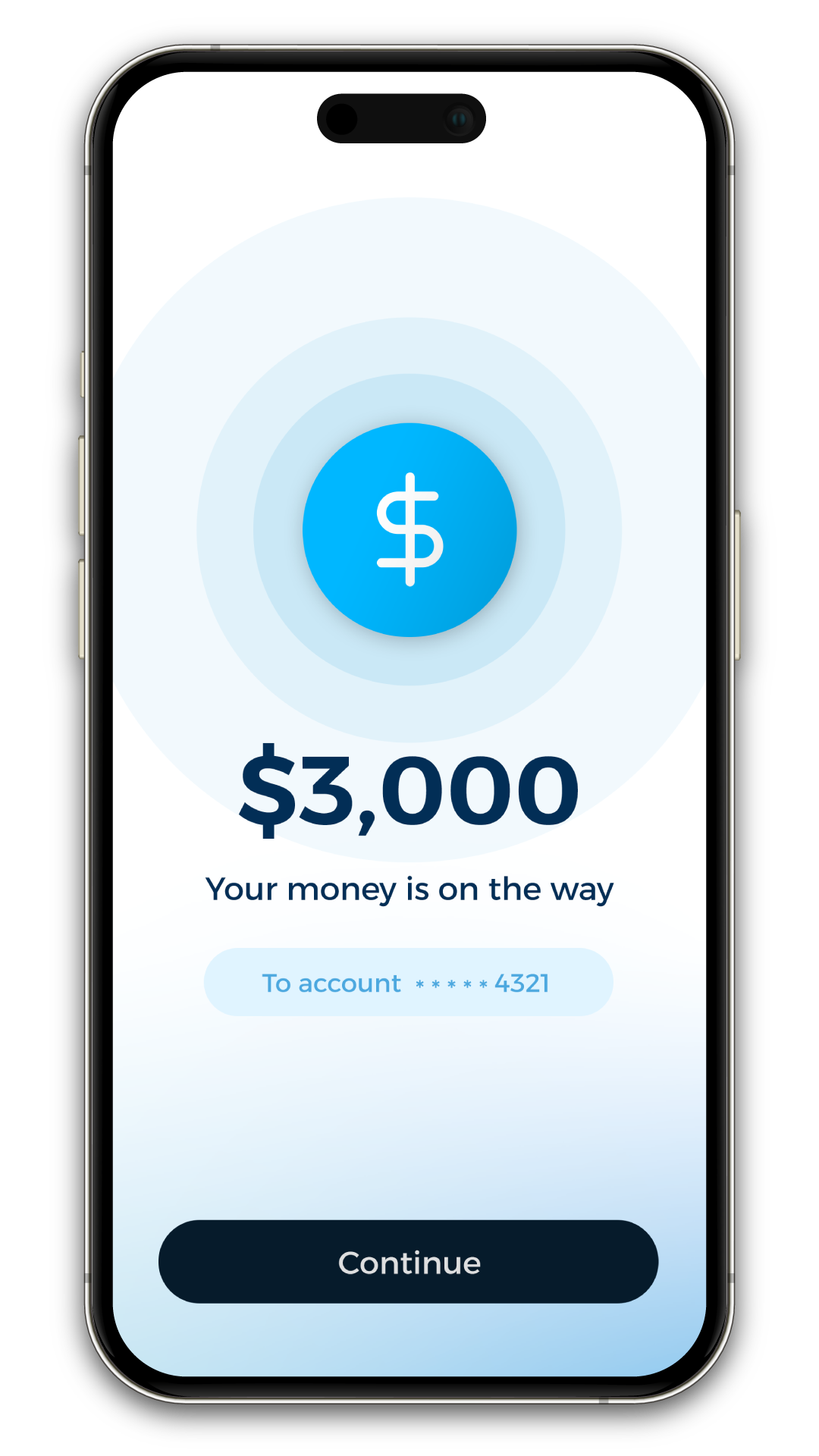
- If your application is processed favorably, your loan funds can be transferred to your bank account or sent via ATH Móvil.
You can Apply with Kiwi in minutes, 100% online.
*Subject to credit approval. Loan amounts may vary by applicant's state of residence.
What happens after you submit your application?
Once your application is received, the Kiwi team reviews your bank statements to check your income and expenses. This step is essential to determine whether there's a repayment capacity that lets you take on the loan installments comfortably and sustainably.
Important: submitting your application does not guarantee approval. All applications are subject to the evaluation process and Kiwi's current eligibility criteria.
Apply for your personal loan in minutes, 100% online. Apply without impacting your FICO® score. Subject to credit approval.
Frequently asked questions
Does applying affect my credit history?
Kiwi runs a soft pull when evaluating your application. This type of inquiry doesn't impact your credit score. Your credit history is part of the evaluation process, along with other factors like your income and banking activity. For more details, visit Kiwicredito.com.
How long does it take to process an application?
You'll get a response by email within 12 to 48 business hours from the time your application is received and your documents are verified.
Do I need to go to a physical branch?
No. Kiwi's entire process is 100% online. You can apply, upload documents, and receive your money without leaving home.
What documents do I need to apply for a loan with Kiwi?
You basically need three things: a verifiable source of income (payroll or proof of income), your bank statements from the last two months, and a valid official ID issued in Puerto Rico.
Does a Kiwi loan help build credit?
Kiwi reports your payments to the major credit bureaus: Equifax, Experian, and TransUnion. Every on-time payment can strengthen your credit history.
Can I apply for a personal loan with an ITIN in Puerto Rico?
It depends on the lender. Some licensed lenders in Puerto Rico accept an ITIN (Individual Taxpayer Identification Number) instead of an SSN, and they usually ask for the ITIN letter, a photo ID, and proof of income. Kiwi's application, however, requires a Social Security number (SSN). If you only have an ITIN, ask each lender what it accepts before you apply.
What determines the interest rate on a personal loan?
Your rate depends on several factors: your credit score, the term, the amount you request, and your overall financial profile. A better history and a shorter term tend to help you get more favorable conditions. The exact rates and their terms are published on each lender's legal or regulated pages, which is where you should confirm them. The CFPB recommends comparing the total cost before you decide.
Key takeaways
- Base requirements: SSN, legal age, active bank account, and a valid official ID.
- Soft pull: applying doesn't affect your credit score, according to the CFPB.
- Amounts: with Kiwi, loans range from $150 to $3,000, terms of 4 to 24 months.
- ITIN vs. SSN: some lenders accept an ITIN; Kiwi requires an SSN.
- PPL Act: in PR, licensed lenders accept applications starting at $150.
- Small Personal Loans Act, Act No. 106 of June 28, 1965 (as amended)
- Office of the Commissioner of Financial Institutions of Puerto Rico (OCIF)
- IRS: Individual Taxpayer Identification Number (ITIN)
- Consumer Financial Protection Bureau: What is a credit inquiry?
- FDIC: 2023 National Survey of Unbanked and Underbanked Households


Get exclusive personal finance and investing content delivered to your inbox.