
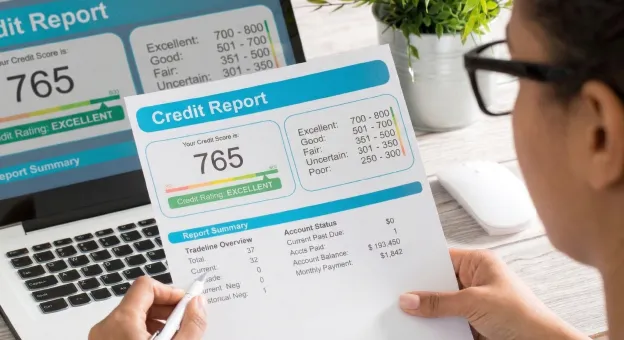

Approximately 12.5% of adults in the United States do not have a scorable credit score: 2.7% have no credit file at all, and another 9.8% have a file that cannot be scored, according to the CFPB report on credit invisibles (June 2025, PDF). If you have never checked your credit, you might be part of that group without even knowing it. Checking your credit for free is the first step toward changing that.
You arrive in the United States, open a bank account, get a job, and pay your bills on time. But when you need a loan or want to rent an apartment, you get rejected. The reason: you don't have enough credit history. Or worse, you have one and don't even know it.
This happens to millions of people. Not because they are irresponsible with money, but because the system doesn't always make access easy. According to the FDIC national survey of unbanked and underbanked households (2023), millions of families in the U.S. still lack full access to the banking system, which makes building a credit history difficult.
Many arrive from countries where credit works differently. Others use an ITIN (Individual Taxpayer Identification Number) instead of an SSN and don't realize that credit bureaus may have a file under their name. And some have simply never received the right information in Spanish.
Knowing your credit score costs nothing. It is the foundation for making financial decisions that truly benefit you. In this guide, you will learn exactly how to check your credit for free, what options you have if you use an ITIN, and what to do with the results.
What a credit score is and why it matters so much
Your credit score is a number between 300 and 850 that summarizes your financial behavior for lenders. It determines whether you get approved for a loan, a credit card, or even a rental agreement, and under what terms. The higher the number, the better the financial options available to you.
The three main credit bureaus in the U.S. are Equifax, Experian, and TransUnion. Each one collects information about your accounts, payments, and debts, and generates a credit report that lenders review before making decisions.
Your score is calculated based on five main factors:
- Payment history (35%): paying on time is the most heavily weighted factor.
- Credit utilization (30%): what percentage of your available credit you are using. Ideally, you should keep it below 30%.
- Length of credit history (15%): older accounts earn more points.
- Credit mix (10%): a mix of credit cards, loans, and mortgages helps.
- Recent inquiries (10%): too many credit applications in a short period can lower your score.
For the Latino community, understanding these factors is especially important. If you come from a country where credit works differently, or if you arrived in the U.S. with an ITIN and no history, every point in your score represents a step toward better opportunities. It’s not just a number: it’s about access to personal loans with better terms, housing, and even employment.
3 free ways to check your credit
There are three completely free ways to check your credit score and credit report without paying a cent and without affecting your score. They all use a soft pull, which means checking your own credit never lowers your score.
1. AnnualCreditReport.com (the official option)
The federal government guarantees your right to obtain a free copy of your credit report from each of the three bureaus every 12 months through AnnualCreditReport.com. According to the CFPB, this is the only authorized source for free reports under federal law (FACTA).
You can request all three reports at once or space them out every four months to monitor your credit throughout the year. The site also offers the ability to check updated reports more frequently online.
If you prefer to do it by phone, call (877) 322-8228. You can also send a request by mail to Annual Credit Report Request Service, P.O. Box 105281, Atlanta, GA 30348-5281.
2. Free apps like Credit Karma or Credit Sesame
Several apps allow you to view your credit score and monitor changes to your credit report at no cost. Credit Karma uses data from TransUnion and Equifax. Credit Sesame focuses on TransUnion. Both use VantageScore, which is a different scoring model than FICO but just as useful for giving you a clear idea of your credit health.
The advantage of these apps is frequency: you can check your score every week and receive alerts when something changes in your report. The downside is that they show an estimated score, not necessarily the same number a specific lender will see.
3. Directly through your bank or credit card issuer
Many banks and credit card issuers in the U.S. offer free access to your FICO score as part of your account benefits. This includes institutions like Discover, Capital One, Chase, and Bank of America. If you have an active account, check your bank's online portal or mobile app.
This method has the advantage of showing you your actual FICO score, the same one many lenders use to make decisions. If your bank offers it, it is the most direct way to see where you stand.
How to check your credit step-by-step
If this is your first time checking your credit, follow these steps:
- Visit AnnualCreditReport.com and select all three bureaus (Equifax, Experian, TransUnion).
- Complete the identity verification using your name, address, SSN or ITIN, and date of birth.
- Review each report for errors: accounts you don't recognize, payments reported as late that you made on time, or incorrect balances.
- Download or print each report for your records.
- If you find errors, file a dispute directly with the corresponding bureau (we explain how later on).
If you prefer ongoing monitoring, download Credit Karma to your phone and create an account. In less than five minutes, you will have access to your score and automatic alerts whenever something changes in your report. Both methods are free and use a soft pull.
How to check your credit if you have an ITIN (no SSN)
If you have an ITIN instead of an SSN, you can request your credit report directly from each credit bureau. The three major bureaus accept requests with an ITIN, although the process requires additional steps that are not always clear in the information available in English.
AnnualCreditReport.com works primarily with SSNs. If your identity verification fails on the site, it does not mean you don't have a credit history. It means you need to request your report through a different channel.
For each bureau, the process is similar:
- Equifax: Call (866) 349-5191 or send a request by mail with a copy of your ITIN and an official ID.
- Experian: Call (888) 397-3742. You can also try online at experian.com using your ITIN instead of your SSN.
- TransUnion: Call (800) 916-8800. You can request your report by phone or by mail.
In all cases, you will need to provide your full name, current address, date of birth, and ITIN. Some bureaus require additional documentation, such as a copy of your ID and proof of address.
If you have never had credit in the U.S. with your ITIN, the bureaus may not have a file under your name. This does not mean anything is wrong; it simply means you do not have a recorded history yet. Options like secured credit cards or products designed to build credit can help you get started. If you are considering a personal loan as a first step, check the requirements in your state first.
Soft pull vs. hard pull: the difference you need to know
A soft pull is a credit check that does not affect your score. It happens when you check your own score, when an employer verifies your history, or when a lender sends you a pre-approved offer. A hard pull can lower your score: according to Experian, a hard inquiry typically lowers your FICO Score by less than 5 points (or between 5 and 10 points for VantageScore) and remains on your report for up to 2 years.
This distinction matters because many people avoid checking their credit for fear of losing points. That is a myth. Checking your own credit is always a soft pull.
According to myFICO, checking your own credit does not affect your score because it is classified as a soft inquiry. According to the CFPB report (June 2025, Table 2), the proportion of adults with an evaluable credit record rose from 81.6% in 2010 to 87.5% in 2020. More people are entering the system. Checking your score is part of that progress.
| Feature | Soft pull (soft inquiry) | Hard pull (hard inquiry) |
|---|---|---|
| Affects your score | No | Yes (<5 FICO points, 5-10 VantageScore) |
| Appears on your report | Only to you | Visible to lenders |
| When it happens | Personal check, pre-approved offers, employment verification | Formal application for credit, a loan, or a mortgage |
| Requires your permission | Not always | Yes, always |
| Stays on your report | Does not affect future evaluations | Up to 2 years |
If you are looking for financing options, look for lenders that use a soft pull for the initial evaluation. Kiwi, for example, uses a soft pull to evaluate your application for a personal loan, which means that applying does not affect your credit score.†
Watch out for scams: no one should charge you to check your credit
Checking your credit report is a free federal right. No legitimate company will charge you to access your own annual report, and any service that demands an upfront payment to "improve" your score should be treated with immediate suspicion.
"Credit repair" scams disproportionately affect the Latino community. According to the CFPB guide, the only authorized source for your free report is AnnualCreditReport.com, not sites with similar names that charge monthly fees.
Red flags you should recognize:
- They ask you to pay before doing any work.
- They promise to remove verifiable negative information from your report (this is illegal).
- They suggest creating a "new credit identity" with a CPN (Credit Privacy Number). According to the FTC, using a CPN to obtain credit under a false identity is a federal crime.
- They do not explain your rights or provide you with a written contract.
If someone offers you these services, report them to the FTC (Federal Trade Commission). You can dispute errors on your report directly with the bureaus, without intermediaries and without paying a cent.
What to do after checking your credit
Once you have your credit report in hand, review it looking for three things: factual errors, accounts you don't recognize, and opportunities to improve your credit profile. This step is where the review stops being informative and becomes concrete action.
According to Experian, if your score is between 670 and 739, you are in the range that lenders consider "good." If it is below 580, access to traditional products is significantly limited. But regardless of where you stand, there are immediate steps you can take.
If you find errors:
- Identify the bureau that has the incorrect information (Equifax, Experian, or TransUnion).
- File a dispute online, by phone, or by mail. Each bureau has its own dispute portal.
- The bureau has 30 days to investigate and respond to you, according to the FCRA.
- If the information is incorrect, they must correct or remove it at no cost to you.
If you want to improve your score:
- Pay all your bills on time. This is the most heavily weighted factor (35% of your score).
- Reduce your credit card balances to below 30% of your limit.
- Do not close old accounts, even if you don't use them. Longevity helps.
- Consider a small installment loan that reports to all three bureaus and helps you build history. Options like those offered by Kiwi, with loans from $150 to $3,000*, use a soft pull for the application and report every on-time payment to TransUnion, Experian, and Equifax.† There is also the Kiwi Credit Builder, a program starting at $5/month that reports to all three bureaus.
Check out our complete credit history guide for a step-by-step plan.
Credit monitoring: your shield for protecting your financial health
Credit monitoring notifies you whenever something changes on your credit report: a new account, an inquiry, a balance change, or an unknown address. It is the most direct way to detect fraud or identity theft before it causes real damage.
Free monitoring options:
- Credit Karma: monitors TransUnion and Equifax. Weekly alerts.
- Credit Sesame: monitors TransUnion. Includes identity theft insurance.
- Your bank: many banks and credit card issuers offer built-in alerts in their apps.
- Fraud alert: you can place a free 90-day alert on your file with any of the three bureaus. The bureau that receives the request shares it with the other two.
If you are a victim of identity theft, you can request a credit freeze with each bureau. This blocks all inquiries until you lift it. It is free and does not affect your score.
If you also have debts you want to organize, check out our guide on how to consolidate debt to evaluate your options. And if you want to build your credit history while monitoring your progress, explore Kiwi's options that report every on-time payment to all three bureaus.*
Checking your credit once a year is a good starting point. Monitoring it continuously is what truly protects your long-term financial health. Visit our FAQ page if you have questions about the process
Apply for up to $3,000


Frequently Asked Questions
Where can I check my credit for free?
You can get your free credit report at AnnualCreditReport.com, which is the only source authorized by the federal government. You can also use apps like Credit Karma or Credit Sesame to monitor your score at no cost. Many banks and credit card issuers provide access to your FICO score within their platforms.
Does checking my credit lower my score?
No. When you check your own credit, it is recorded as a soft pull, which has no effect on your score. Only hard pulls, which occur when you formally apply for a loan or credit card, can affect your score. You can check your credit as often as you like without worry.
How often should I check my credit?
At a minimum, review your full credit report once a year with each bureau. If you are planning to apply for a loan or mortgage, check it three to six months in advance to correct any potential errors. If you use a free monitoring app, a weekly score check will keep you updated on any significant changes.
How can I check my credit without affecting my score?
Use any of these three free options: AnnualCreditReport.com for your full report, an app like Credit Karma for ongoing monitoring, or your bank's portal if it offers access to your FICO score. All of these options use soft pulls and will not deduct points from your credit score. You can also look for lenders that perform soft pulls before you submit a formal application.
How can I check my credit for free with an ITIN?
If you have an ITIN instead of an SSN, request your credit report directly from each bureau by phone or mail. Equifax: (866) 349-5191. Experian: (888) 397-3742. TransUnion: (800) 916-8800. You will need your full name, address, date of birth, ITIN number, and a copy of your ID. The annual report is free by law.
What does it mean to have a good credit score?
According to the FICO Score ranges published by Experian: 300-579 (poor), 580-669 (fair), 670-739 (good), 740-799 (very good), and 800-850 (excellent). A score of 670 or higher gives you access to most financial products with competitive terms. Every point counts, and every on-time payment reported to the bureaus moves you closer to a better range.
How do I dispute errors on my credit report?
Identify the error and the bureau reporting it. File a dispute online (each bureau has its own portal), by phone, or by mail, including supporting documentation. The bureau has 30 days to investigate under the FCRA. If the error is confirmed, they must correct it at no cost. The FCRA (Fair Credit Reporting Act) protects your right to an accurate report and to dispute incorrect information.
Key Points
- Your credit score ranges from 300 to 850 and is based on payment history, credit usage, and account age.
- AnnualCreditReport.com is the official source for free reports under the FACTA law.
- A soft pull does not affect your score; a hard pull can lower it by less than 5 points (FICO) for up to 2 years.
- The three bureaus (Equifax, Experian, TransUnion) accept requests with an ITIN by phone or mail.
- Bureaus have 30 days to investigate and correct errors you dispute on your report.
- CFPB - Technical Correction and Update to the CFPB's Credit Invisibles Estimate (June 2025, PDF)
- CFPB - How Do I Get a Free Copy of My Credit Reports?
- FDIC - 2023 National Survey of Unbanked and Underbanked Households
- OCC - Credit Reporting: Consumer Protection
- AnnualCreditReport.com - Free credit reports
- FTC - Consumer Reports: What Information Furnishers Need to Know
- Experian - How Long Do Hard Inquiries Stay on Your Credit Report? (2025)
- Experian - What Is a Good Credit Score? (2025)
- myFICO - Does Checking Your Credit Score Lower It?
- FTC - Fixing Your Credit FAQs